Many companies are now setting their budgets for 2027, and for HR and L&D teams this is a time of difficult decisions. The labor market is changing faster than plans can be updated, AI is reshaping roles, and people are tired. So how do you plan talent development under these conditions?
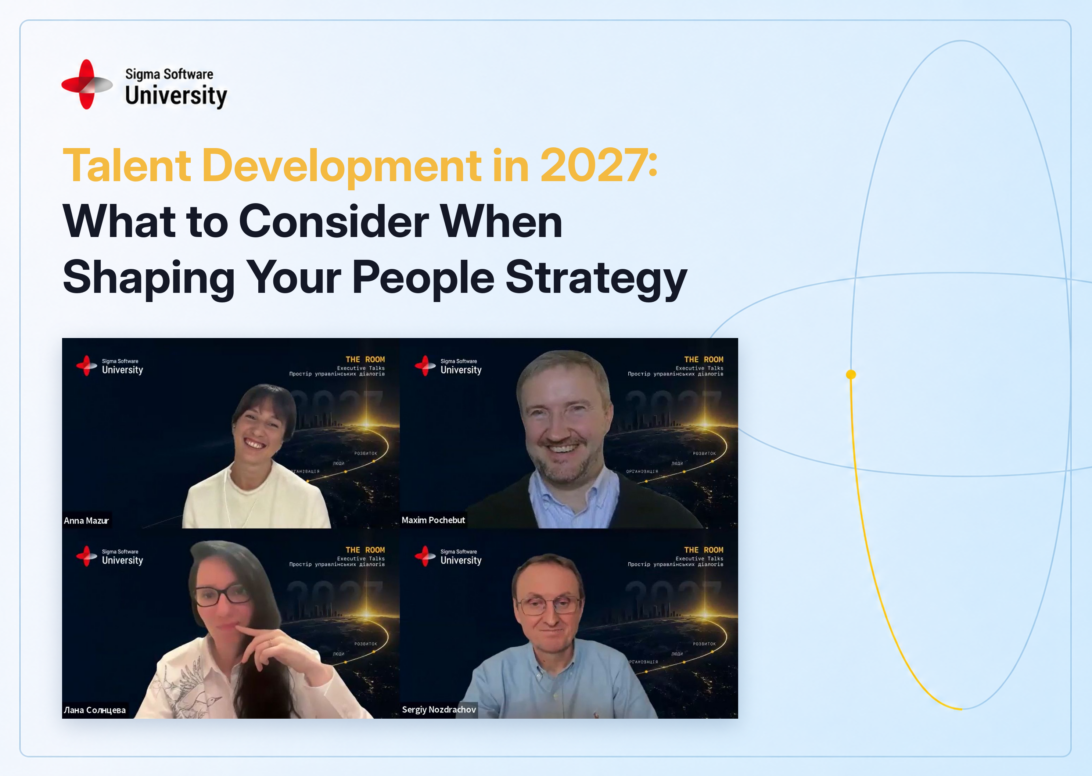
We explored this question on October 29 at the panel discussion “Talent Development in 2027.” It was the first conversation of THE ROOM, a new format of executive dialogues from Sigma Software University. The panel featured Sergiy Nozdrachov (Kyiv-Mohyla Business School, Gallup-certified talent development expert), Anna Mazur (Happy Monday, Loud&Proud), and Lana Solntseva (Talent Partners). The discussion was moderated by Maxim Pochebut, Chief Learning Officer at Sigma Software and CEO of Sigma Software University.
Below, we have gathered the main points of the conversation and the conclusions you can draw from them for next year’s employee development plan.
AI exposes weak management
Some managers already have AI agents doing the work of an entire department. Does this mean middle management will become unnecessary?
Most AI projects still deliver very little real ROI, and the reason usually lies with people, not tools. According to the panelists’ observations, the lowest productivity and the highest burnout are found in teams where one manager has more than 20 direct reports. People need their manager’s attention, so the problem is not how many managers a company has, but how well they manage. In the past, weak spots in management could be covered with extra resources. AI makes them far more visible.
Another observation: companies have already learned to use AI for the work they knew how to do anyway. Learning to work in a new way is much harder: building agents, integrating systems, redesigning processes. The best place to start is routine work and internal processes, so that people have more time for tasks that require human judgment.
At the same time, the role of middle managers is changing. They are becoming people who understand both technology and management and know how to teach others. A labor market foresight study discussed at the panel predicts that demand for mentors will grow. The panelists believe that mentoring should become a separate, permanent role rather than a bonus for a few extra hours a week.
The panel also discussed fractional management, where an experienced leader works with a company part-time. This format can give a team a fresh perspective and experience from other companies, provided the person shares the company’s values and is accountable for part of the results. But people often choose this format because they are exhausted and no longer have the energy to commit fully to one company. Globally, there is already talk of managers around the age of 40 increasingly stepping away from leadership roles, and the reason is fatigue from the pace of change.
Plans are made for weeks, but people are developed over years
Just a few years ago, Ukrainian companies planned five to ten years ahead. Now most plan for two to three. And since late summer, many decisions, including hiring decisions, have been made within a single week. Some businesses have abandoned strategy altogether, believing that right now they need to survive, not grow. The panelists disagree: deciding how to get through a crisis is a strategic decision too.
This creates an obvious tension for talent development. Decisions have to be made quickly, but skills cannot be built in a week. One approach discussed at the panel is to keep several horizons in mind at once: the next few weeks, the coming season, and the distant future. And then check whether today’s decisions serve all three.
Interestingly, even companies that are currently cutting staff leave their critical employees and high-potential employees (HiPos) untouched. Their plans for these people are long-term, and their development is becoming a budget priority.
How to learn when people are exhausted
War and prolonged stress affect people’s ability to learn, and employers need to take this into account. A person may have high cognitive potential, but under stress their attention narrows and they cannot use their knowledge to the full.
The simplest change that helps here is to stop treating learning as something for “evenings or weekends.” In Ukraine’s current reality, people rarely have energy left in the evening. It works much better when learning is in the work calendar, ideally in the morning, and the manager treats it as a regular work task.
Another idea from the discussion is to make people-centricity one of a manager’s KPIs. Then managers will monitor their team’s workload themselves, and in one-on-ones they will ask not only “What have you done?” but also “How are you doing, and what do you need?” This does not always require extra money. Often, finding a budget is easier than changing the mindset of the owner or senior leadership.
More candidates, but broader requirements
According to Happy Monday, a platform that works mainly with office and digital roles, the number of vacancies fell by 15% between April and October, while the number of applications rose by 84%. Competition for every position has increased noticeably.
At the same time, employers expect more from candidates, and this is visible not only in Ukraine but also, for example, in the German market. A product manager needs to understand code and design. A developer delegates part of the routine to AI and thinks more about the product. A designer who does not understand business logic and metrics finds it hard to compete. Where companies once hired three people, they now often look for one.
The panelists agree that these changes are irreversible. The strongest position belongs to those who can learn, adapt, and understand why their work matters to the business. There is also a noticeable trend toward slash careers: people take on side projects or pet projects to try out new skills without risking their main job.
No ready-made specialists, so companies train their own
In manufacturing, logistics, and energy, there are simply not enough people, and ready-made specialists are nowhere to be found. Companies hire people without the necessary skills and train them in-house. This is expensive and slow, but in many industries there is no other way left to fill positions.
That is why learning no longer looks like an add-on to HR’s work. For many companies, it is a regular business process, like sales or finance. The same foresight study, which involved almost 150 experts, points in this direction too. One of the trends for the next decade is the gap between what businesses need and what people can do. The education system is not keeping up with these changes, so most of the burden will fall on employers, especially large businesses. And it is quite possible that, over time, a short certificate will carry more weight than several years of university.
Individually, as a team, or together with other companies?
In tech companies, development budgets are increasingly going to individual training and certifications. This kind of learning is easier to focus on key people and easier to measure. At the same time, demand is growing for corporate programs where a team learns together.
Another trend is the desire to learn alongside peers from other companies. People want to hear other companies’ cases and look at their own challenges from the outside. This is why mixed formats are emerging, where teams from several companies go through a program at the same time. It is equally important that knowledge does not stay with one person: after a course, it is worth sharing what you learned with the team.
Still, the format is not the main thing. People learn differently, and the result depends on whether the company has found out what a person actually needs. The foresight study calls this people-centricity. When learning takes into account the needs of both the business and the employee, that employee will not leave the company, even if they study in external programs or speak at conferences.
Cross-functionality and the ROI of learning
Courses alone are not enough to make people cross-functional. The biggest obstacle is a rigid hierarchy. Cross-functionality emerges where people are allowed to work in other teams and projects, are given room to make mistakes, and receive timely feedback. Here, traditional businesses have something to learn from IT and its project teams.
As for the ROI of learning, universal formulas often fail in practice. The value of learning becomes visible through culture, when every manager creates a learning environment in their team and becomes a mentor for it. To do this, a manager needs to know their own strengths and the strengths of the people on the team, and be able to organize how they work together. They also need to understand their own manager and know how to influence them.
What to invest in for 2027
If we boil the conversation down to a few practical conclusions, they look like this.
- Learning during working hours. To keep learning from being pushed to the evening, build it into the work schedule and treat it as part of the job.
- Developing middle managers. They carry the heaviest workload, yet they are the ones who determine whether a team develops a culture of learning and mentoring.
- A new way of working with AI. Access to tools is not enough. People need the skills to redesign processes.
- Learning with people from outside. The experience of other companies gives you what no internal course can.
- Measuring potential, not just costs. Look at how quickly people create new value amid change, and develop critical and systems thinking.
- Culture and team well-being. The panelists recommend taking a closer look at the concept of flourishing, which research links to productivity and resilience. They also remind us to start with ourselves: a manager who knows how to rest and keep learning will pass this on to the team.
And perhaps the shortest summary of the whole conversation came at the very end: people need people.
How to apply this to your employee development strategy
Before you approve your 2027 training plan, ask yourself a few questions:
- Does the plan include both short formats for current tasks and longer programs for key roles?
- Do people have time for learning in their work schedule?
- Who is developing your middle managers?
- Can your employees apply AI in their own processes, or do they simply have access to the tools?
- Do your people get to see how other companies work?
At Sigma Software University, we design corporate training around the goals of each specific company, using cases from the team’s real work. For companies adopting AI, we offer AI education and solutions for every level. And for teams that need to close skill gaps quickly, we run upskilling programs.
To explore the topic further, read our articles on measuring the business impact of learning and team mental health.
The conversation continues: meet THE ROOM
This discussion showed once again how important it is to have a space where you can openly discuss difficult questions, compare experiences, and look at challenges from different angles.
It was with this discussion that we launched THE ROOM — Executive Talks, a new space for leadership dialogues from Sigma Software University. Here, we will bring together executives and experts to talk about people, leadership, technology, and business growth.
Fewer monologues, more live discussion. Fewer ready-made answers, more perspectives and hands-on experience.
New topics, new speakers, and new conversations are ahead. Stay tuned for announcements!
FAQ
What talent development trends will matter in 2027?
Employers increasingly have to train people themselves, role requirements are becoming broader, AI is changing the role of managers, and mentoring and a people-centered approach to development are becoming more important.
Which is better: individual or group corporate training?
Both formats work, for different goals. Individual training is easier to focus on key people and to measure, while group training, especially alongside teams from other companies, brings new cases and shared understanding. What matters more than the format is whether the training meets the real needs of the person and the business.
How do you organize employee training when the team is exhausted?
Set aside working time for it, ideally in the morning, and agree on it with the manager as part of the job. It also helps to keep an eye on workload and to regularly ask people in one-on-ones what they need.
Other articles